

How to Spot Jupiter in the Evening Sky
Why Jupiter is the easiest planet to find
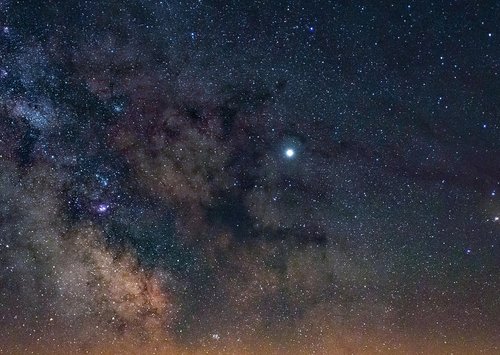
If you have ever noticed an unusually bright, steady point of light in the evening sky and wondered whether it was a star, there is a good chance it was Jupiter. For much of the year this giant planet outshines everything else in the night sky apart from the Moon and, occasionally, Venus, and it does so with a calm, unblinking glow that gives it away.
At its best, Jupiter shines at around magnitude –2.5. That is roughly ten times brighter than Sirius, the brightest star in the sky. It also sits close to the ecliptic, the same broad track across the sky that the Sun and Moon follow, which means it always turns up somewhere within the familiar zodiac constellations rather than wandering off into the far north or south.
Best of all, Jupiter is genuinely rewarding through modest equipment. A pair of ordinary binoculars, held steady, is enough to reveal its four largest moons — the same four that Galileo spotted in 1610. You do not need a telescope, dark skies, or any particular expertise. You need a clear evening, a little patience and somewhere you can rest your elbows.
When and where to look
Jupiter is an evening object for months at a time, but it is not equally well placed throughout. The key moment is opposition, when Earth sits directly between Jupiter and the Sun. This happens roughly every thirteen months, and for a few weeks either side of it Jupiter rises as the Sun sets, stays visible all night, and appears at its largest and brightest.
Away from opposition, Jupiter still shows well but may not rise until later in the evening, or may sink low in the west soon after dusk. If you cannot find it where you expected, it has probably simply moved on along the ecliptic.
To locate it:
- Face the direction of sunset after dusk and scan the sky for the brightest point of light you can see.
- Use the Moon as a signpost. Each month the Moon passes close to Jupiter over the course of an evening or two, and that pairing is often the easiest introduction you will get.
- Check a printed star chart or a planetarium app on your phone — the display will be dimmed if you set it to red night mode.
- Look when Jupiter is highest in the sky. Objects low near the horizon are dimmed and blurred by extra atmosphere.
Telling Jupiter from a star
The classic test is twinkling. Stars are so distant that they appear as points of light, and their light is easily disturbed by the turbulent air above us — hence the familiar flicker. Jupiter shows a small disc, so the turbulence averages out and it shines with a steady, creamy-white light.
Two caveats are worth remembering. Close to the horizon, even Jupiter will twinkle, because you are looking through a much thicker slice of atmosphere. And an aeroplane heading towards you, with its landing lights on, can look uncannily planet-like for a few seconds. If the bright point is moving steadily, and especially if it has a faint red or green companion light, it is not Jupiter.
Seeing Jupiter’s four largest moons
This is the moment binocular stargazing becomes genuinely thrilling. Any pair of 8x40 or 10x50 binoculars will show the four Galilean moons — Io, Europa, Ganymede and Callisto — as tiny points of light strung out in a line either side of the planet. Follow that line, and you are looking at a miniature solar system roughly 600 million kilometres away.
The moons change position noticeably from night to night, and sometimes from hour to hour. You may see all four on one side, two on each side, or only three, because one is passing in front of or behind the planet. A sketch made on one evening and repeated a week later makes a lovely record of their stately dance.
- Rest the binoculars on a fence, wall or car roof, or use a tripod adaptor. Hand-held views of small moons are possible but wobbly.
- Focus carefully on Jupiter first, then look just to either side without moving the binoculars.
- Give your eyes at least twenty minutes to adapt to the dark, and shield yourself from street lights and phone screens.
- Try again on several nights — steady air matters more than perfect darkness for this particular target.
Getting a better view
A small telescope at around 50x magnification will begin to show the two dark equatorial belts that stripe Jupiter’s cloud tops. At 100x or more, on a night of steady seeing, the planet becomes a disc rather than a dot, and the Great Red Spot occasionally reveals itself as a pale notch in the southern belt. Because Jupiter spins in under ten hours, features rotate across the visible face in a single session.
Be patient with magnification. Pushing too high on a restless night gives you a larger but mushier image. A sharp view at 80x beats a blurry one at 200x every time.
A few last thoughts
Jupiter rewards regular, casual observation. Note where it sits against the background stars this week, then look again in a month and you will see it has shifted noticeably along the ecliptic — the visible signature of a planet on its twelve-year journey around the Sun. Its light has taken the best part of an hour to reach your eyes, and the four small sparks beside it were first seen by Galileo through a telescope far poorer than the binoculars sitting in your kitchen drawer.
tag: Planets

Priya Patel Author
Learn why Venus appears near sunrise or sunset, how its phase changes, and where to look during different observation windows.
YOU MAY ALSO LIKE
Tracking Venus Through Morning and Evening
Aug 9
10Discover how aperture and atmospheric steadiness affect ring detail, and which magnifications work best for steady seeing on typical nights.
read more
Saturn's Rings: What to Expect from a Small Scope
Aug 7
10Use dark autumn evenings and star hops from Cassiopeia or Pegasus to locate this faint smudge without optical aid.
read moreStargazing
-

ERRIC CATONA
Scan below Orion's Belt to find a glowing patch, then compare its shape with photographs taken through different apertures.
May 19, 2016 at 5.12 pm
Reply
ERRIC CATONA
Explore the Pleiades, Hyades, and Double Cluster, noting how binocular views reveal colours and patterns hidden from urban eyes.
May 19, 2016 at 5.12 pm
Reply -
ERRIC CATONA
Plan routes with familiar paths, avoid isolated areas, and share your timetable so others know when to expect your return.
May 19, 2016 at 5.12 pm
Reply
Telescopes
Your email address will not be published.