
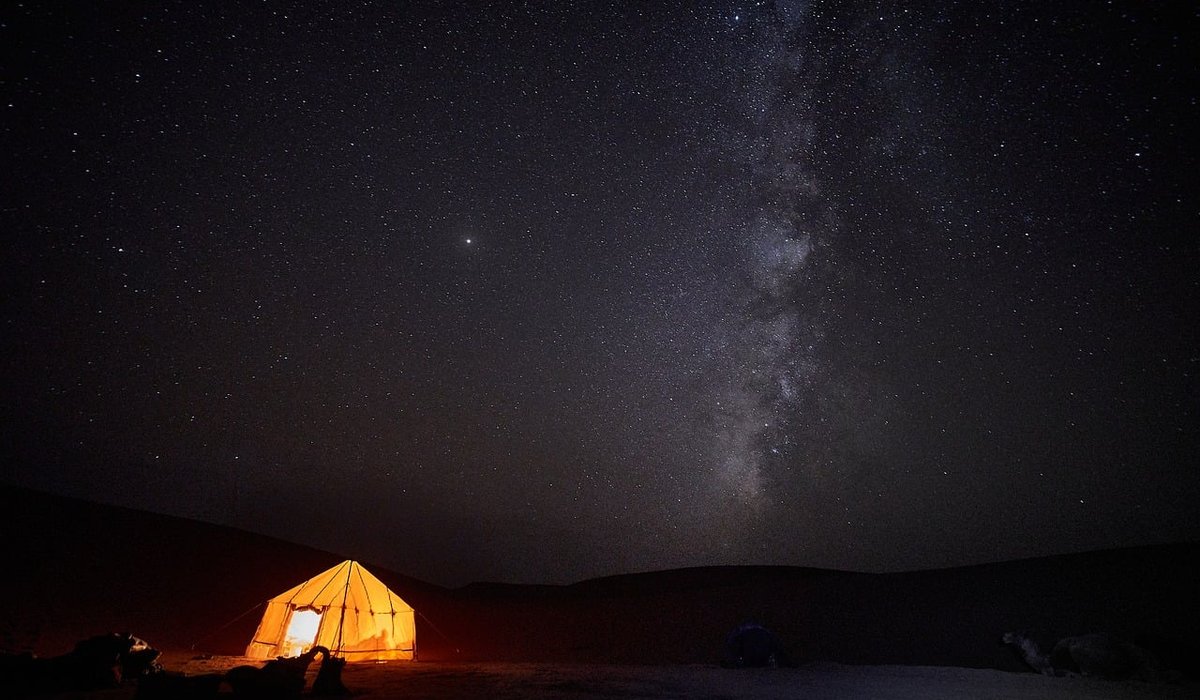
How to Find the North Star in UK Skies
There is something quietly thrilling about standing in a dark garden or on a windswept moor, tipping your head back, and finding your way around the sky. For anyone in the UK, the first and most useful signpost is Polaris, the North Star. It is not the brightest star in the sky, but it is the most reliable. Learn to find it and you unlock a compass that works on any clear night, in any season, without a phone signal or a battery.
Why Polaris Holds Still While the Sky Turns
Earth spins on an axis that points almost directly at Polaris. As a result, while every other star appears to wheel around the sky, Polaris stays put. Its altitude above the northern horizon is roughly equal to your latitude. In the UK, that means between about 50 and 60 degrees. From Cornwall it sits lower; from Shetland it is higher. This makes it a permanent marker — and the key to orienting yourself anywhere in the British Isles.
Step One: Find the Plough
The Plough is part of Ursa Major, the Great Bear. It looks like a saucepan with a bent handle: four stars forming the bowl, three forming the handle. It is circumpolar in the UK, meaning it never sets, but it does rotate around Polaris. On spring evenings it is high overhead; in autumn it sits low along the northern horizon. To find the North Star, you only need the bowl.
- Find the two stars at the end of the bowl furthest from the handle. These are the Pointers.
- Imagine a line connecting them, then extend that line away from the handle about five times the distance between the two stars.
- Your line lands on a moderately bright star sitting alone in a relatively empty patch of sky. That is Polaris.
Step Two: Confirm You Have the Right Star
Polaris is similar in brightness to the stars of the Plough — not dazzling, but easy enough once you know where to look. It forms the end of the handle of the Little Dipper (Ursa Minor), a fainter constellation that can be hard to see from towns. A good check is to look for Cassiopeia, the distinctive W-shaped constellation on the opposite side of Polaris from the Plough. The North Star lies roughly halfway between the two. Polaris is also almost exactly due north. If you have a compass, it will point within a degree or so of true north — close enough for stargazing.
When the Plough is Hidden: Use Cassiopeia
Trees, buildings, or low cloud can obscure the Plough. Cassiopeia is your backup. Its five bright stars form a W or M shape, depending on how it is tilted, and it sits on the opposite side of Polaris. If you can see the W, the North Star lies in the direction of its middle point, about the same distance from Cassiopeia as the Plough is on the other side. In autumn, when the Plough is low, Cassiopeia is high — and vice versa. Between them, you can find Polaris on any clear night of the year.
Using Polaris to Navigate the Night Sky All Year
Once you have Polaris, you have a fixed pivot. All other stars appear to rotate around it anticlockwise when you face north. This lets you find constellations in any season. For example, follow the arc of the Plough’s handle to reach Arcturus and then Spica. Use the Pointers in the opposite direction to locate Leo. In winter, Orion rises in the east while Polaris stays put; in autumn, the Square of Pegasus climbs in the south. Because Polaris is due north, you can orient yourself instantly: face it and east is to your right, west to your left. That simple fact turns any star chart into a practical map.
Practical Tips for UK Stargazers
Finding Polaris is easy, but seeing it well depends on conditions. Here are some specifics for the UK.
- Light pollution: From a city centre you might only see a handful of stars. Polaris is often visible even in towns, but the Plough can be washed out. Head to a dark-sky site if you can — Exmoor, Northumberland, Galloway Forest, and the South Downs are excellent. Even a village with no streetlights makes a difference.
- Best seasons: Polaris is visible all year, but the Plough is highest on spring evenings, making it easiest to spot. In autumn, look low to the north. In winter, it is well placed later in the evening. Summer twilight can be tricky, especially in northern Scotland where true darkness never fully arrives in June.
- Equipment: Your eyes are enough. Give them 20 minutes to adapt to the dark. Use a red torch to preserve night vision. Binoculars help reveal the fainter stars of the Little Dipper, but start with the naked eye.
- Orientation: Magnetic north differs from true north by a few degrees in the UK, but for stargazing the difference is negligible. Face north, look up at your latitude angle, and there it is.
With a little practice, finding Polaris becomes second nature. It is a quiet companion on every clear night, a fixed point in a turning sky. So next time you step outside after dark, take a moment. Find the Plough, follow the Pointers, and say hello to the North Star.
tag: Stargazing

Eleanor Hartley Author
Set up a comfortable viewing spot, choose a few easy targets, and learn how to read a basic star chart without expensive equipment.
YOU MAY ALSO LIKE
Getting Started with Back Garden Stargazing
Sep 21
10Discover how to plan around radiant points, moonlight, and local weather to improve your chances of spotting shooting stars.
read more
Best Time to See Meteor Showers
Sep 18
10Compare small refractors, reflectors, and spotting scopes, focusing on portability, light gathering, and ease of use in towns.
read moreStargazing
-

ERRIC CATONA
Follow a daytime alignment routine using a distant landmark, then refine it at night with a bright star or planet.
May 19, 2016 at 5.12 pm
Reply
ERRIC CATONA
Use gentle tools and safe solutions to remove dust and smudges, protecting optical coatings and avoiding scratches on delicate surfaces.
May 19, 2016 at 5.12 pm
Reply -
ERRIC CATONA
Understand the lunar cycle, from new moon to full moon, and learn why phases appear differently depending on your viewing time.
May 19, 2016 at 5.12 pm
Reply
Telescopes
Your email address will not be published.